

Pikler climbing triangle, climbing arch, or climbing frame? The ultimate comparison
A climbing triangle, a climbing arch, or perhaps a large indoor climbing frame? Anyone looking for a climbing toy for children will soon realize that there is plenty to choose from. But which model is best suited to their child and the space available at home?
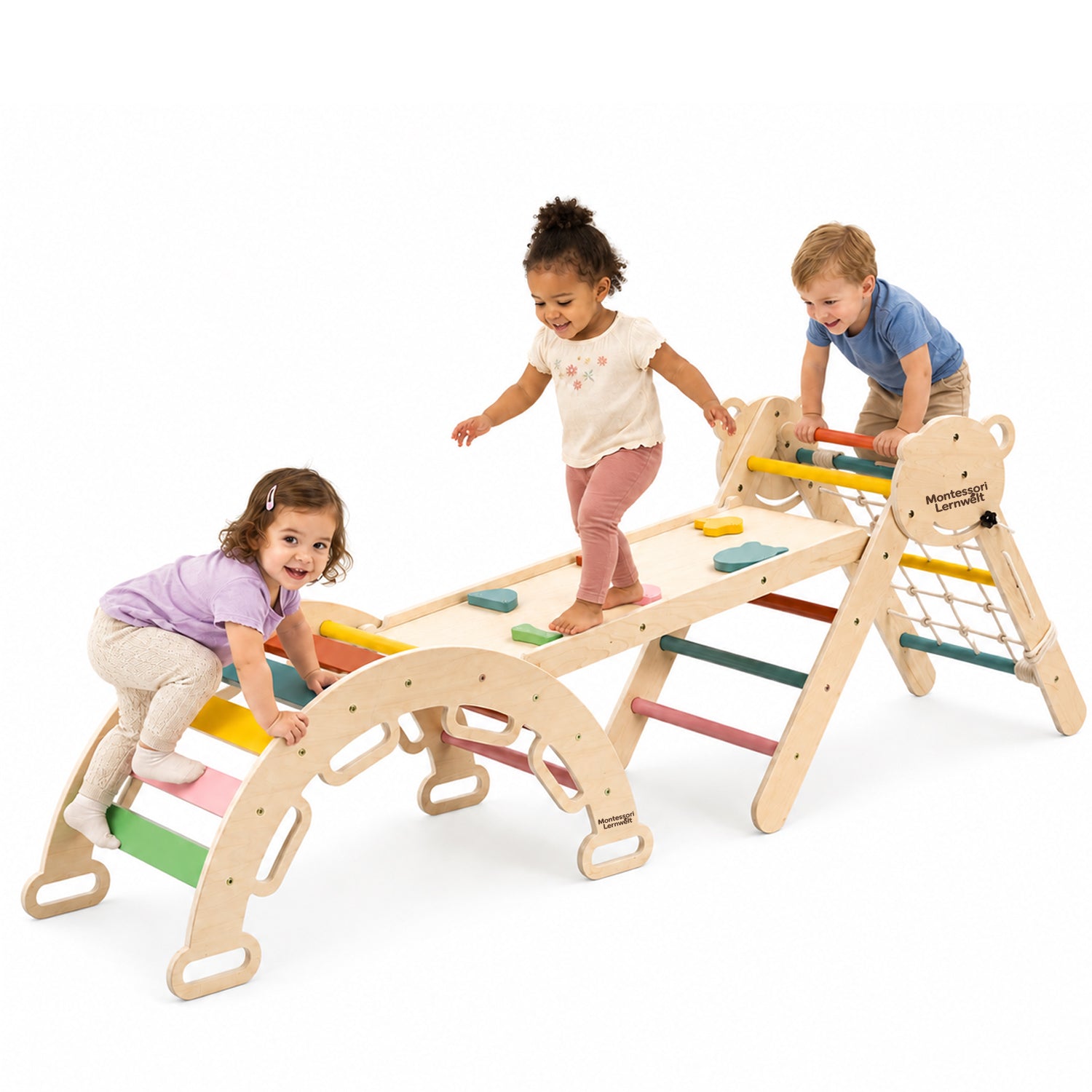
The different climbing toys vary not only in shape, but also in their play options and the space they require. Many modern climbing sets also combine several elements. For example, a set may include a climbing triangle, a climbing arch, and a ramp.
In this guide, we explain the key differences and compare five different climbing toys using three essential questions: Which model is right for my child's age and abilities? How much space do I need? And which climbing set offers the most play options?
- Climbing triangles provide a classic foundation for first climbing experiences.
- Climbing arches expand movement options with their curved design.
- Combined climbing sets bring several elements together in one product.
- Large indoor climbing frames offer a variety of movement activities in one area.

1. Climbing triangle: The classic foundation for climbing
The climbing triangle is one of the best-known Montessori and Pikler movement toys. Its triangular structure with rungs lets children try out their first climbing movements and gradually develop their physical abilities.
What makes a climbing triangle special?
- Encourages independent climbing attempts.
- Promotes balance and body coordination.
- Can be complemented with a ramp or other elements, depending on the model.
- Available in different sizes and designs.
A simple climbing triangle can already offer a variety of movement opportunities. Adding elements such as a climbing ramp or climbing arch makes play even more varied.
Climbing triangle or combined climbing set?
Not every climbing triangle is a standalone piece of equipment. Many modern climbing sets combine several structures.
One example is a 4-in-1 climbing set that combines a climbing triangle, climbing arch, and ramp. This lets children explore different ways to move without needing several separate play structures.
The 8-in-1 Pikler climbing set also combines various play elements and offers additional opportunities for active play sessions.

Climbing triangle, climbing arch, and ramp in one set – for varied climbing and physical activities.
View product2. Climbing arch: A curved design with versatile possibilities
The climbing arch differs from the classic climbing triangle mainly in its curved shape. Depending on its design, it can be used for climbing, crawling, balancing, or other play ideas.
What play options does a climbing arch offer?
- Climb over the arched structure.
- Crawl under the arch.
- Build balance and body control through movement.
- Use suitable models as a swing or activity piece.
- Use with a matching cushion as an additional play or resting area.
A climbing arch doesn't have to be used on its own. It can also be part of a larger climbing set and be combined with a triangle or ramp.
When is a standalone climbing arch a good choice?
A standalone climbing arch may be a good choice if you're looking for a versatile activity piece that can be incorporated into different play ideas.
One example is the Montessori 6-in-1 Climbing Arch. At 80 × 40 × 44.5 cm, it takes up relatively little floor space. The matching cushion measures 107 × 36.5 cm.

A versatile activity piece with an arched design for a variety of play ideas in the children's room.
View productA climbing triangle and a climbing arch are not mutually exclusive. Combined climbing sets can include both structures, complementing each other with different play options.
3. Indoor climbing frame: Multiple physical activities in one play area
An indoor climbing frame goes beyond the classic triangular or arched structure. Here, different activity elements are combined into a larger play and activity station.
Depending on the model, these may include a slide, a swing, a climbing wall, a wall ladder, or gymnastic rings, for example.
Climbing frame with slide and swing
A model with a slide and swing combines different physical activities. Children can climb, slide, and swing, trying out different movement patterns.
The model shown is about 120 cm tall. The base structure is specified as approximately 106 cm long. The slide is about 122 cm long. For use, you should also allow enough clear space in front of the slide and in the swing area.

Several ways to move in one play area - for climbing, sliding, and swinging.
View productClimbing frame with gymnastic rings
Another option is an indoor climbing frame with a vertical Swedish ladder and gymnastic rings. This model focuses on a variety of climbing and hanging movements.
The model is about 215 cm high, 76 cm wide, and 58 cm deep. In addition to the floor space it takes up, consider the room height and the extra space needed for the gymnastic rings.

A comprehensive activity station for children who enjoy climbing and trying out different gymnastic elements.
View product4. Which climbing toy is right for each age?
Age can provide an initial guide when choosing a product. However, children develop at different rates. Their motor skills, previous experience, and the information provided by the manufacturer are also key considerations.
| Developmental stage | Suitable climbing structure | What should you look for? |
|---|---|---|
| First movement experiences | Age-appropriate, lower climbing elements | Stability, low-level challenges, and safe supervision |
| Some climbing experience | Climbing triangle or suitable climbing set | Body coordination and independent movement |
| More movement experience | Climbing sets with an arch and ramp | Different ways to move and new challenges |
| Active children | Larger indoor climbing frames | A variety of activities and enough space |
For the first climbing attempts
For younger children, the focus is initially on exploring, holding on, pulling themselves up, and making their first independent movements. An age-appropriate climbing element can provide early experience with different movements.
For children with some climbing experience
As children become more confident, they are often interested in more varied movement challenges. A climbing set with a triangle, arch, and ramp can offer additional ways to play at this stage.
For children with more movement experience
Children who already climb confidently and enjoy trying new challenges may also enjoy larger indoor climbing frames with multiple elements.
Always check the age recommendation on the relevant product page. A child should not use a climbing frame just because they have reached the stated age. Their actual abilities and the supervision required also play an important role.

5. How much space do you need for a climbing toy?
The available space is a key factor when choosing a product. A climbing toy should not only fit in the room, but also leave enough room to move around while using it.
Comparing the actual dimensions of our five climbing toys
The following dimensions provide an initial guide. Please note that some models have multiple elements that can be used separately or combined. The space required may therefore vary depending on the configuration.
| Product | Dimensions | Space planning |
|---|---|---|
| 4-in-1 Climbing Set | Triangle: 94 × 53 × 78 cm Arch: 96 × 53 × 50 cm Ramp: 98 × 35 cm |
Several elements that take up different amounts of space depending on the configuration. |
| 3-in-1 Pikler Climbing Set | Triangle: 83.6 × 42 × 80 cm Additional component: approx. 83.6 cm long |
Compact main structure; depends on the selected combination. |
| Indoor climbing frame with slide & swing | Height: 120 cm Main structure: approx. 106 cm long Slide: approx. 122 cm |
Additional space is needed in front of the slide and in the swing area. |
| 6-in-1 Climbing Arch | 80 × 40 × 44.5 cm Cushion: 107 × 36.5 cm |
Relatively compact footprint, also suitable for smaller play areas. |
| Climbing frame with gymnastic rings | 215 × 76 × 58 cm | Tall structure; consider ceiling height and the space needed in front of the equipment. |
Which models are suitable for smaller rooms?
If space is limited, it is worth considering more compact designs. For example, the 6-in-1 climbing arch measures 80 × 40 × 44.5 cm. The 3-in-1 Pikler climbing set is also relatively compact, with a triangular base measuring 83.6 × 42 cm.
With a 4-in-1 climbing set, you should consider that several elements may be used at the same time. The space required varies depending on the combination and arrangement.
When is more space needed?
Larger indoor climbing frames offer additional movement activities, but also require more space. Especially with slides and swings, consider not only the dimensions of the equipment, but also the additional space needed for movement.
With a 215 cm-high climbing wall with gymnastic rings, the available ceiling height is also important. Before purchasing, check that the equipment, including its intended use, fits in the room.
6. What play options do the five models offer?
In addition to the space required, the variety of movement activities is also important. The overview below shows you at a glance which activities the five models offer.
✓ Climbing Arch
✓ Ramp / Slide Board
✓ Climbing Arch
✓ Ramp / Slide Board
✓ Sliding
✓ Swinging
✓ Climbing Wall and Climbing Net
✓ Climbing Arch
✓ Rocking and other play ideas
✓ Wall bars
✓ Gymnastic rings
✓ Slide and climbing elements
Note: The exact features and items included may vary by model. Please refer to the respective product description.
A versatile play structure can combine different activities. However, the model with the most features isn't automatically the best choice. What matters is whether the included play options suit your child and your family's daily routine.
7. Which climbing toy is the right choice?
Once you've learned about the differences, dimensions, and play options, it's easier to narrow down the choices.
If you want to combine as many climbing elements as possible
A 4-in-1 climbing set combines a triangle, arch, and ramp. It's a good option for families who want to use several climbing structures in one set.
If you're looking for a compact arch structure
With dimensions of 80 × 40 cm, the 6-in-1 climbing arch takes up a relatively small amount of floor space and can be incorporated into different play ideas.
If your child enjoys sliding and swinging
An indoor climbing frame with a slide and swing combines different physical activities in one play area.
If you're looking for a tall climbing and gymnastics station
The climbing frame with gymnastic rings features a vertical wall bars and additional gymnastics elements. Be sure to pay particular attention to the ceiling height.
Conclusion: The right climbing toy depends on your child and your home
Whether it's a climbing triangle, climbing arch, or large indoor climbing frame, each structure offers different possibilities. Many modern climbing sets even combine several elements.
A climbing triangle provides a classic structure for climbing. A climbing arch expands the range of movement with its curved shape. Larger indoor climbing frames combine different activities in one play area.
Before you decide, it's best to ask yourself three questions:
Take your child's individual motor skills and previous experience into account.
2. How much space do I have?
Compare the actual product dimensions and allow enough room to move around.
3. Which activities does my child particularly enjoy?
Consider whether the main focus should be climbing, balancing, sliding, swinging, or gymnastics.
How to find a climbing toy that not only looks interesting at first glance, but can also suit your child's interests and daily routine in the long term.